Key points
- Administrators have excessive control and pose a security risk
- Encryption empowers users to control their own data
- VDI centralizes computing resources while maintaining data isolation
- Encryption and VDI increase security and simplify CMMC 2.0 compliance by reducing scope and complexity
Summary
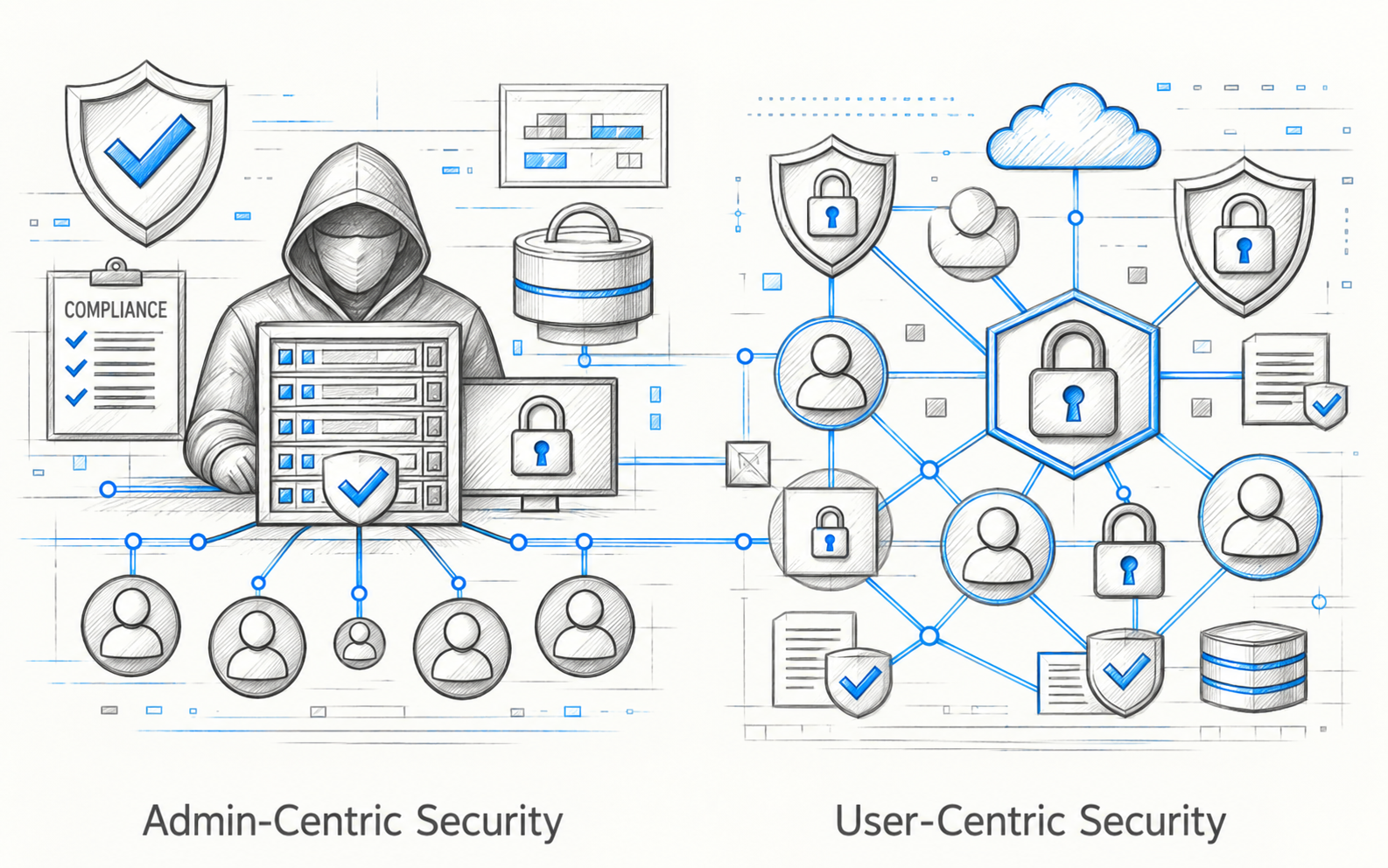
In traditional security models, administrators hold significant power over the system, acting as gatekeepers, maintaining security, access, and permissions. While this centralized approach gives admins full visibility into data and activities, it also creates a single point of failure. If an admin account is compromised, attackers can gain unrestricted access, posing a serious risk of system-wide breaches. Moreover, the concentration of power increases the risk of insider threats, as a compromised admin could misuse their elevated privileges.
The user-centric security model is emerging as the smarter, more resilient alternative to traditional methods. By transferring control from administrators to users, it significantly reduces the risks inherent in centralized systems. In a traditional setup, admins are responsible for safeguarding sensitive information, making their accounts a prime target for attacks. The user-centric model flips this dynamic by empowering individuals to manage their own data access. This shift minimizes the attack surface, leading to a more robust defense against breaches.
Cryptography and Virtual Desktop Infrastructure (VDI) are crucial components of this approach. VDI centralizes desktop management while ensuring user data is isolated and protected within an enclave, even from administrators. This clear separation of duties—where admins handle infrastructure management but have no access to user data—creates an additional layer of security that is far less vulnerable to compromise.
For organizations aiming to meet Cybersecurity Maturity Model Certification (CMMC) 2.0 Level 2 requirements, the user-centric model offers additional benefits. User computers that function solely as terminals can be classified as “Out-of-Scope,” significantly simplifying compliance efforts. By reducing the risk of administrator compromise and isolating data, this model delivers a more secure and compliant solution for modern organizations.
The Role of Cryptography in User-Centric Security
Cryptography is the cornerstone of user-centric security, ensuring that data remains secure both at rest and in transit. Through private-public key cryptography, secure authentication and key exchange mechanisms enable only authorized users to access or share data. This cryptographic foundation strengthens the principle of user ownership, ensuring that even administrators cannot access or manipulate data without the user’s explicit consent. It adds an extra layer of defense, making it highly resistant to external or internal threats, including compromised admin-level accounts.
Hardware Support via Virtual Desktop Infrastructure (VDI)
Virtual Desktop Infrastructure (VDI) plays a crucial role in user-centric security, offering the computational power to centralize desktop management while ensuring that sensitive data remains inaccessible to administrators. In a VDI environment, users maintain full control over their data while benefiting from centralized security measures and resource management. This centralized setup enables secure access to data, with VDI administrators managing the infrastructure but having no access to the data itself, reinforcing the separation of duties that is critical to user-centric security.
Separation of Duties in User-Centric Security
A defining principle of security is the separation of duties. By distributing responsibilities across multiple roles - such as VDI administrators, system administrators, and end-users - organizations can reduce the risk of insider threats and ensure that no single individual has complete control over the system. VDI administrators handle the management and configuration of virtual machines, while system administrators manage user accounts without access to decryption keys. This clear division ensures that the infrastructure remains secure, even from those responsible for its management.
Simplifying CMMC 2.0 Level 2 Compliance
Under CMMC Level 2, contractor assets are classified into five categories: Controlled Unclassified Information (CUI) Assets, Security Protection Assets, Contractor Risk Managed Assets, Specialized Assets, and Out-of-Scope Assets. The first four categories are considered in-scope because they handle CUI or contribute to its security.
However, Out-of-Scope Assets, which neither process, store, nor transmit CUI, fall outside the CMMC requirements. This is where VDI solutions offer a significant advantage. By using VDI, users’ computers function solely as terminals, accessing CUI through virtual machines rather than handling CUI directly. As a result, these user terminals can often be classified as Out-of-Scope assets. This classification not only reduces the compliance burden but also streamlines the security management process, making it easier for organizations to meet CMMC requirements without compromising on security.
tiCrypt: A Scalable, Secure Solution
tiCrypt, developed by Tera Insights LLC, is designed for environments requiring secure storage, sharing, and processing of CUI. With end-to-end encryption and compliance with CMMC 2.0, tiCrypt supports the user-centric model by isolating user data from infrastructure managers. Its blockchain audit capabilities, secure VM clusters, and High-Performance Computing (HPC) support make it both secure and high-performing.
Scalable for on-premises deployment, tiCrypt ensures NIST 800-171 compliance, simplifying security management and giving users control over their data. In a rapidly evolving security landscape, traditional models lack the flexibility to combat sophisticated threats. tiCrypt, combining cryptography, VDI, and separation of duties, meets CMMC 2.0 and NIST 800-171 requirements while empowering organizations to maintain full data control. With a proven track record - independent external audits certifying compliance with NIST 800-171 and CMMC 2.0 level 2, tiCrypt is the strategic choice for security-focused organizations.
For more detailed technical insights into how tiCrypt can enhance your security infrastructure, check out the tiCrypt whitepaper https://ticrypt.com/whitepaper.
Disclaimer: The information provided in this blog entry is intended for general informational purposes only and may not reflect the most current developments or regulations. While every effort has been made to ensure the accuracy and completeness of the content, the author and publisher make no representations or warranties regarding the accuracy, reliability, or completeness of the information. Readers are encouraged to consult relevant professionals or official sources for specific guidance and advice related to their individual circumstances. The use of this information is at the reader’s own risk.